SSPINNpose: A Self-Supervised PINN for Inertial Pose and Dynamics Estimation
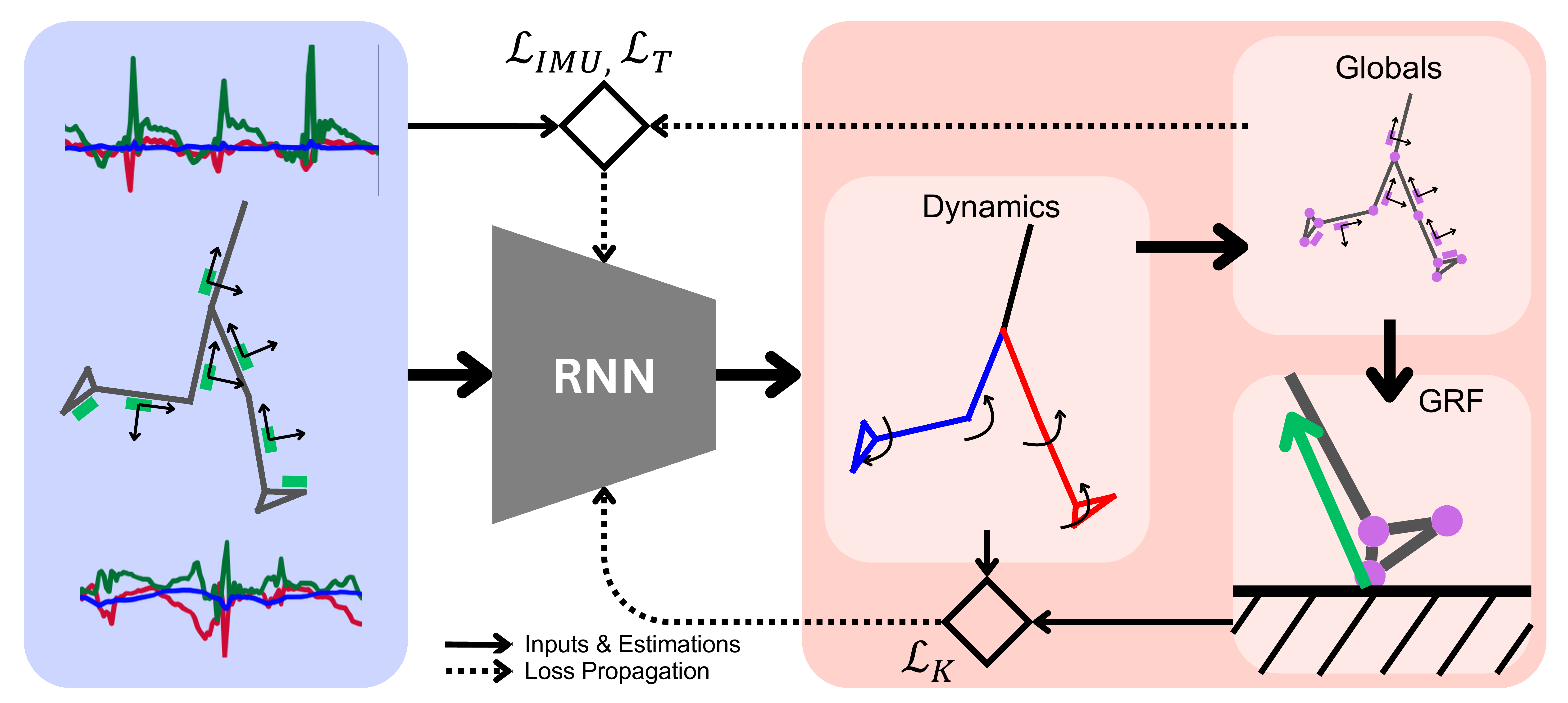
Accurate real-time estimation of human movement dynamics, including internal joint moments and muscle forces, is essential for applications in clinical diagnostics and sports performance monitoring. Inertial measurement units (IMUs) provide a minimally intrusive solution for capturing motion data, particularly when used in sparse sensor configurations. However, current real-time methods rely on supervised learning, where a ground truth dataset needs to be measured with laboratory measurement systems, such as optical motion capture. These systems are known to introduce measurement and processing errors and often fail to generalize to real-world or previously unseen movements, necessitating new data collection efforts that are time-consuming and impractical. To overcome these limitations, we propose SSPINNpose, a self-supervised, physics-informed neural network that estimates joint kinematics and kinetics directly from IMU data, without requiring ground truth labels for training. We run the network output through a physics model of the human body to optimize physical plausibility and generate virtual measurement data. Using this virtual sensor data, the network is trained directly on the measured sensor data instead of a ground truth. When compared to optical motion capture, SSPINNpose is able to accurately estimate joint angles and joint moments at an RMSD of 9.1 degrees and 3.8 BWBH%, respectively, for walking and running at speeds up to 4.9 m/s at a latency of 3.5 ms. Furthermore, the framework demonstrates robustness across sparse sensor configurations and can infer the anatomical locations of the sensors. These results underscore the potential of SSPINNpose as a scalable and adaptable solution for real-time biomechanical analysis in both laboratory and field environments.

Motions can be reconstructed from sparse IMUs, for example, using only IMUs mounted at the Feet + Thighs (FT), Feet + Shanks (FS), Thigh + Shanks (TS), or Shank + Pelvis (SP).
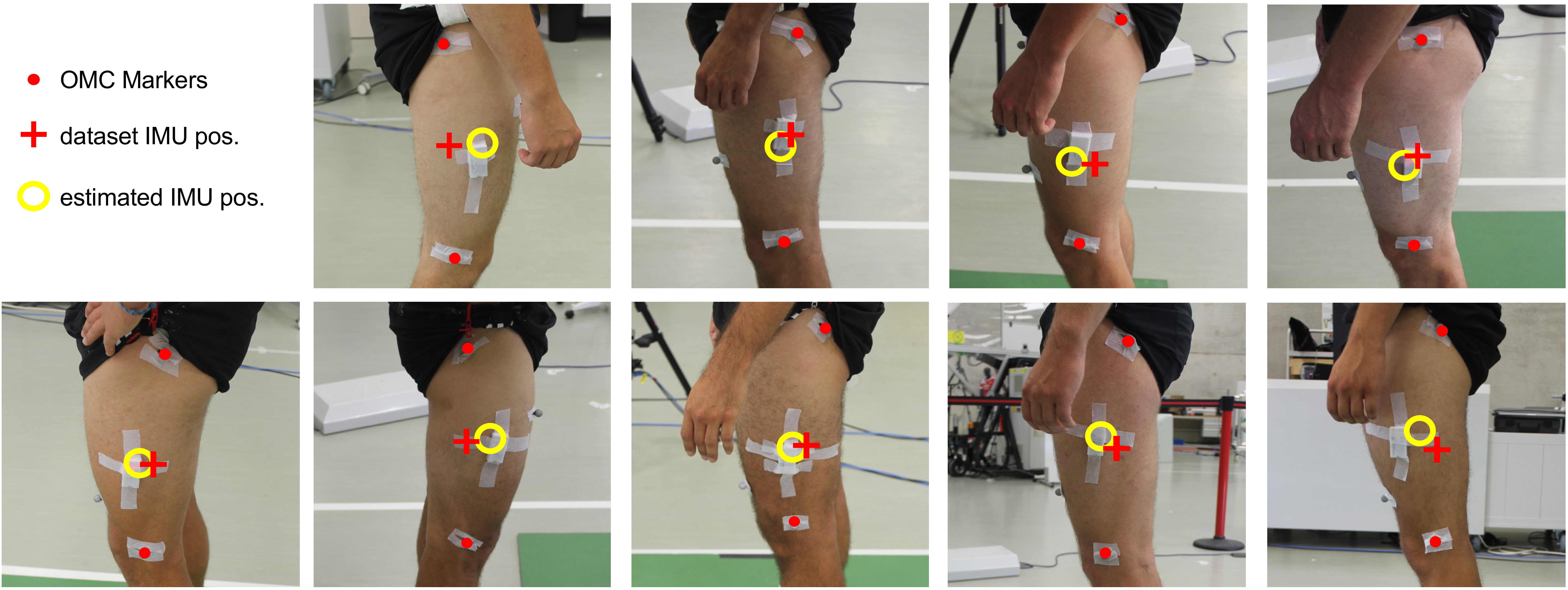
SSPINNpose can identify the anatomical locations of the IMUs when freezing the neural network weights and optimizing for the sensor positions. The figure shows the optimized sensor positions compared to the manually measured sensor positions from the dataset.
Cite the paper
Use the following BibTeX entry when referencing SSPINNpose.
@article{gambietz2025sspinnpose,
  title   = {SSPINNpose: A Self-Supervised PINN for Inertial Pose and Dynamics Estimation},
  author  = {Gambietz, Markus and Dorschky, Eva and Akat, Altan and Schockel, Marcel and Miehling, Jorg and Koelewijn, Anne D.},
  journal = {ACM Transactions on Intelligent Systems and Technology (TIST)},
  year    = {2026},
  doi     = {10.1145/3806199}
}